
RE:EXPANSION
Joan Cox and the intimacy that refuses to disappear
Joan Cox did not crack this year.
She was protected.
“I have a heavy suit of Joan of Arc armor on,” she says, “and it has protected me from cracks.” It’s a line that could sound defensive in the wrong mouth. In hers, it sounds earned. Armor, here, is not hardness. It is the accumulation of years spent insisting on visibility when discretion was the price of survival. It is the muscle memory of having painted queer love long before it was welcomed, long before it was marketable, long before institutions learned how to pronounce it without flinching.
That armor didn’t keep her from returning to what had been abandoned.
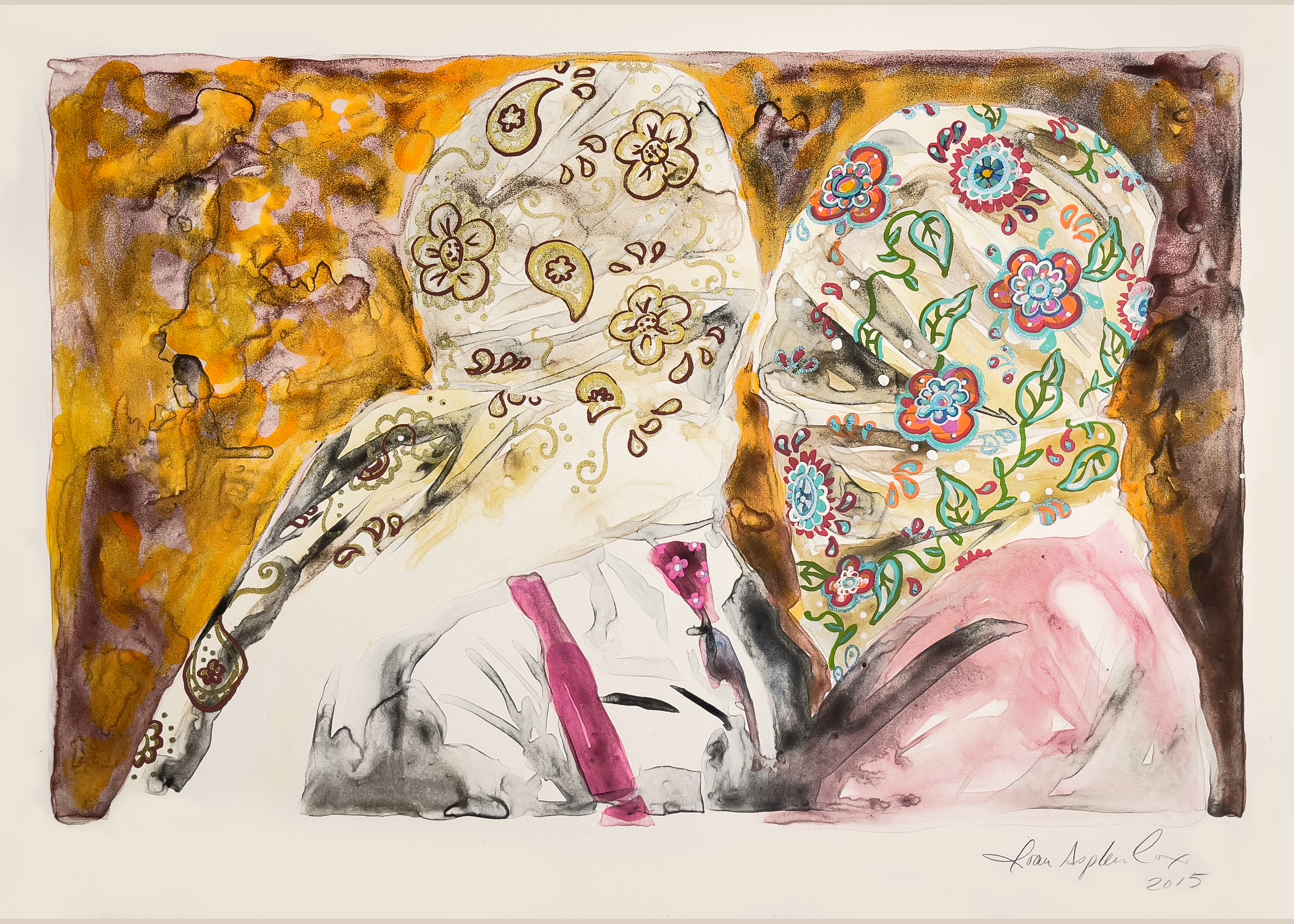
This year, Cox opened drawers she hadn’t touched in more than a decade—works on paper, watercolor monotypes that never quite landed, prints that misbehaved, images that didn’t cooperate the first time around. They had been ignored not because they were wrong, but because the moment wasn’t ready for them. Neither was she.
What she found wasn’t failure. It was possibility.
After years of working primarily in large-scale narrative oil paintings, Cox reached for oil pastels, markers, liquid charcoal, pens. She smudged pigment with her fingers. She drew directly onto softness. She reentered the work not as a revisionist, but as someone newly willing to embellish intimacy rather than protect it.
“I wanted to take these quiet, tender prints and give them a bolder language,” she explains. “To celebrate what they were already holding.”
That celebration took the form of pattern, color, and ritual. Cox adopted the visual language of calaveras face paint—not as decoration, but as inheritance. A way of honoring loved ones not temporarily, but eternally. In her hands, the tradition becomes a bridge between queer memory and queer futurity, between the domestic and the devotional. These are not portraits of mourning. They are acts of continuity.
This return to paper coincided with a deepening of collaboration—something Cox describes not as expansion, but as heartbeat.
Early in 2024, she was approached by photographer Morgan Lieberman, whose project focused on the intimacy of elder lesbian couples. The photographs were unguarded, unperformed, full of trust. Cox responded not by copying them, but by translating them—pulling the images into oil paintings and watercolors that slowed time without sterilizing it.
“There was something about the immediacy of Morgan’s work,” Cox says. “It reminded me of what I’m after—affection without staging.”
That exchange—lens to brush—became a conversation about what intimacy looks like when it’s allowed to age. Not spectacle. Not nostalgia. Just presence.
Another collaboration followed, this time rooted in language. As Cox prepared for a solo exhibition at Towson University, her alma mater, the Dean encouraged her to work with Dylan Volk, a modern and contemporary art historian whose scholarship maps lesbian aesthetics at the turn of the millennium. Volk suggested framing the exhibition through the poetry of Adrienne Rich, another Baltimorean whose work has long refused silence.
The exhibition took its title from Rich’s poem Side by Side. The pairing was not illustrative. It was structural. Shared language meeting shared image. Two forms of articulation recognizing one another across time.
“These collaborations expanded my process,” Cox reflects. “They reminded me that art is conversation. And that growth happens in dialogue.”
That belief—art as dialogue rather than declaration—threads through Cox’s engagement with TBQA. Each week, she participates in the Bureau’s online residency, sharing work with artists across geographies and cultural contexts. It functions as a testing ground, a site of recalibration. Not critique for critique’s sake, but collective seeing.
Preparing for the IMMORTAL Queer Art Fair in Mexico City became another pivot. Immersed in a different cultural rhythm, Cox found permission to reapproach her most intimate narratives—stories of enduring love between women—with new visual strategies. The embrace of Día de Muertos symbolism didn’t feel borrowed. It felt offered.
“There was a sense of welcome,” she says. “It gave me freedom to experiment.”
That freedom surfaces vividly in Cartographies of Hidden Hearts (2025), a watercolor monotype layered with acrylic and oil pastel. The work does not announce itself. It maps. Figures emerge through pattern and translucence, bodies marked by care rather than exposure. These are not lovers posed for consumption. They are lovers allowed interiority.
Cox has always reclaimed domestic space as a site of resistance. Kitchens, bedrooms, bathtubs—these are not backdrops in her work. They are battlegrounds made holy through repetition. Her paintings insist that queer life is not radical because it is transgressive, but because it is sustained.
That insistence carries cost.
For years, Cox worked within institutions where queer content was discouraged, where intimacy had to be coded or softened. That repression did not silence her. It distilled her. She learned how to use the classical language of oil painting—so often employed to immortalize heterosexual fantasy—and turn it toward mutuality instead of domination.
“I’ve always painted from my own experiences,” she says. “Even when I couldn’t show them. Even when I was told not to.”
What emerges now is not defiance for its own sake, but clarity. Cox is less interested in recognition than in visibility. Less interested in novelty than in continuity. The quiet victories matter more than the loud ones: returning to abandoned work, trusting collaboration, allowing tenderness to remain central without apology.
Rebirth, for Cox, is not a rupture. It is a retrieval.
She carries forward a truth that feels newly sturdy: that intimacy—domestic, erotic, ordinary—is not a soft subject. It is a durable one. It survives drawers, decades, and institutional indifference. It waits patiently to be taken back up.
And when it returns, it does so armored not against feeling, but against erasure.
That may be the instruction Joan Cox was never given, but learned anyway:
that tenderness, practiced daily, is not fragile.
It is what lasts.