
Walking Enigma
On Briheda Haylock and the discipline of self-possession
This feature is part of Vol. 13: The Queer Gospel—an ongoing meditation on transformation, rupture, and the quiet, radical act of becoming. It is presented in dialogue with our current exhibition, The Queer Gospel | Resurrection, on view through April 18 in Mexico City.
The full magazine will be released on Sunday, April 6—Easter Sunday—as a free downloadable PDF, or available as a printed edition through our website.
Briheda Haylock does not arrive at their work through uncertainty. The uncertainty comes from everything around it. When they speak about what had to change, it is not framed as internal confusion or artistic doubt, but as a recalibration of boundaries. “Letting go of energy vampires, narcissists, and those unwilling to do the work has become necessary,” they say. The clarity of that statement is not defensive—it is structural. It defines the conditions under which the work can exist without being diluted by the expectations of others.
“My challenge has never been execution—it’s the distractions,” they explain. What they are naming is not a lack of discipline, but the opposite: a refusal to carry the weight of other people’s avoidance. The work requires a level of honesty that not everyone is willing to meet, and when that gap appears, it is often the artist who is labeled difficult. Haylock does not correct that perception. They move around it.
“Knowing that I deserve better,” they say, “is what remains.”
That knowledge settles into the work as a kind of stillness. Not passivity, but grounded presence. It allows them to remain where they are without shrinking the scale of what they are doing. “It’s not that I need to run away from where I am,” they say, “but rather trust that I can stay rooted, allow the work to speak for itself, and let it grow in its own way.” There is a refusal here—not of place, but of limitation. The work does not need relocation to expand. It carries its own movement.
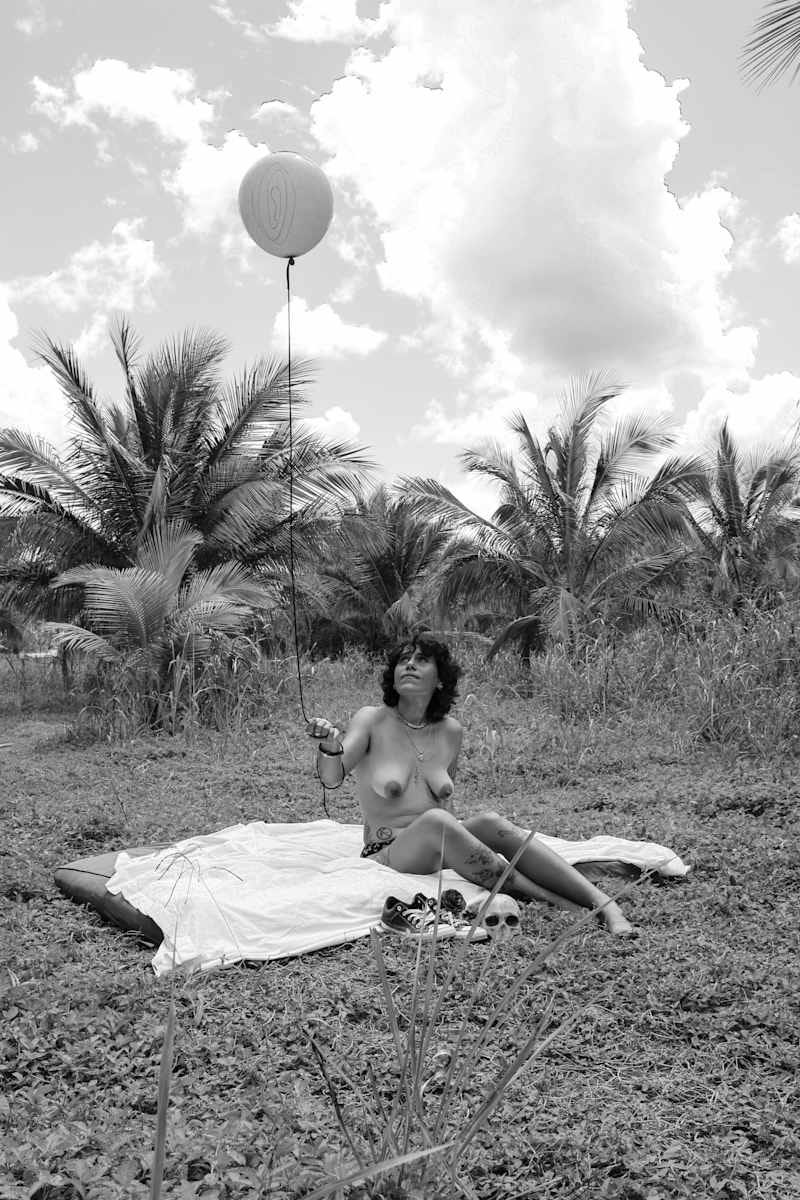
In the image, that stillness becomes visible. The body is placed directly within the landscape, not staged against it but held inside it. There is no attempt to conceal or dramatize the nude form. It is present, unguarded, and yet not available in the way the gaze might expect. The figure looks upward, not outward. The balloon rises above, lightly tethered, a line that suggests connection without weight. Around them, the environment continues without interruption—grass, palm, sky—indifferent and expansive at once.
Nothing is being performed for the viewer, and that absence is what holds the image open.
“At the end of the day, I am simply a vessel for something greater than myself as an artist,” Haylock says. The word vessel lands differently when placed against the image. It does not diminish authorship; it expands it. The body is not positioned as object, nor as symbol, but as a site through which something moves—something that does not need to be named in order to be felt.
That shift is echoed in how they describe their relationship to making. “It no longer comes from a place of need,” they explain, “but from a genuine desire to create.” The urgency has changed form. It is no longer driven by the pressure to produce, but by the clarity of what is worth saying. When the world becomes unstable, that clarity sharpens. “Happiness, clarity, and wholeness,” they say, describing what the act of making provides.
The simplicity of that answer carries more weight than it appears. It suggests that the work is not a reaction to instability, but a way of maintaining coherence within it.
That coherence does not eliminate risk. “In my society, everything I do feels like a risk,” they say. The visibility of the work—its openness, its refusal to soften—invites response, and not all of it is grounded in understanding. There is a tendency to mistake vulnerability for accessibility, to assume that what is shown can be defined from the outside.
“I am a walking enigma—you only know what I allow you to know.”
The image reinforces that boundary. The body is visible, but not exposed in the way the viewer might expect. The gaze is redirected. The presence is self-contained. What is offered is deliberate, and what remains withheld is equally intentional. The work does not close itself—it clarifies its terms.
That clarity becomes more complex as they return to their own voice after years of working in collaboration and community. The shift is not immediate. “Reconnecting with my personal voice feels like speaking to a stranger,” they say. There is distance there, but also patience. They do not rush to resolve it. They allow the unfamiliarity to exist, to unfold into something that cannot be forced.
“I am trying to give myself that space again,” they explain.
What emerges from that space is not a dramatic transformation, but a return of energy. Not a new version of the self, but a recognition of something that was interrupted and is now reappearing. “My energy feels like it has returned to itself—before the deception, the betrayal, and the misguided choices,” they say. The past remains present, but it no longer dictates the direction. It informs without enclosing.
There is a clarity in how they hold that position. The path they describe is not collective in the conventional sense. “The lone wolf path may appear lonely… but in truth, it is where I hold my power.” That power does not rely on validation. It is anchored in recognition. The ability to remain steady, to resist being shaped by external pressure, to understand when to stay and when to step away.
“I know who I am—and I know where the door is.”
Even in moments of heaviness, that awareness does not disappear. The response is not to push through blindly, but to pause. To observe. “It’s important to understand what you’re feeling so you can move forward,” they say. When language fails, abstraction takes over—not as avoidance, but as a method of sorting what belongs from what does not.
“There is no lesson there—it was simply a temporary feeling that didn’t belong to me.”
The distinction is precise. Not everything needs to be carried. Not everything needs to remain.
Rest becomes part of that clarity. Time in nature. Listening. Not for answers, but for direction. “I listen for the whispers of my ancestors,” they say, describing a relationship that moves beyond the immediate, beyond the visible. The image holds that presence without naming it. The landscape is not background. It participates.
What the work sustains is not a fixed message, but a position. A refusal to be defined from the outside. A commitment to clarity without explanation. A recognition that presence, when held fully, does not require performance.
It is enough to remain.
And to know, without hesitation, when to step through the door.